
LISTED PROFILE
Kimi
Kimi, developed by Moonshot AI, is a productivity-focused AI assistant powered by the K3 model—a 2.8-trillion-parameter long-context LLM. Designed for research and document workflows, Kimi enables users to summarize long files, convert briefs into formatted Office documents and presentations, generate and debug code, and perform source-linked deep web searches. It also supports multi-agent collaboration via group-chat workflows and seamlessly syncs across web, desktop, and mobile platforms.Read full overviewCollapse overview
Kimi, developed by Moonshot AI, is a productivity-focused AI assistant powered by the K3 model—a 2.8-trillion-parameter long-context LLM. Designed for research and document workflows, Kimi enables users to summarize long files, convert briefs into formatted Office documents and presentations, generate and debug code, and perform source-linked deep web searches. It also supports multi-agent collaboration via group-chat workflows and seamlessly syncs across web, desktop, and mobile platforms.
Last checked2026-09-17
01 — OUR TAKE
Who and what it suits
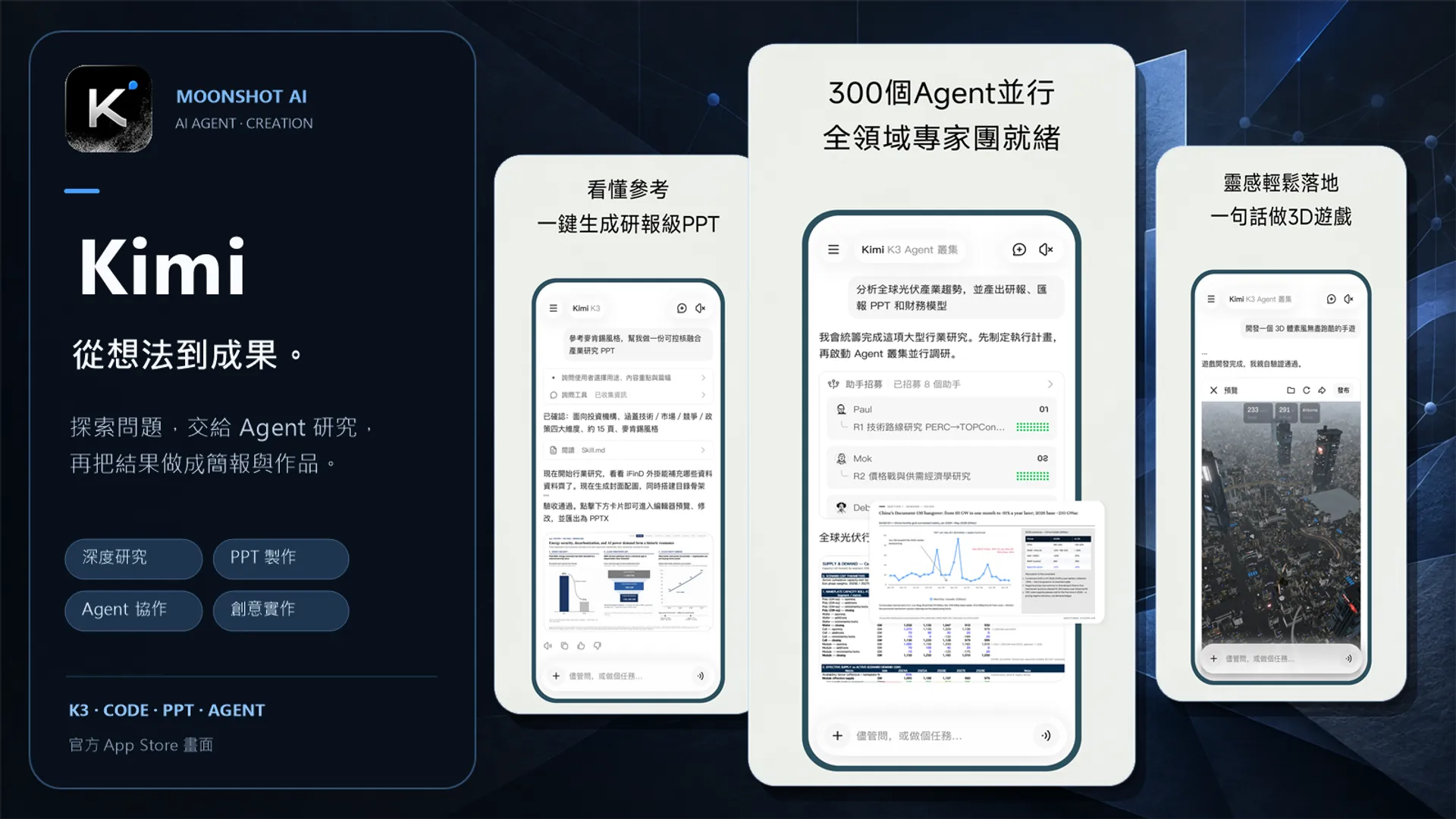
According to official store listings and public documentation, Kimi positions itself as an enterprise- and research-grade AI assistant driven by Moonshot AI's K3 model. Key highlights include long-context document analysis, native PPT/Office document generation, code generation from UI frames, and deep search with explicit source citations. Available free with tiered in-app subscription options, Kimi supports multi-device synchronization across iOS, desktop, and web interfaces. Per its privacy policy, de-identified interaction data may be utilized for model optimization unless an opt-out is requested via customer service. Performance claims regarding multi-agent clusters and execution speeds reflect vendor-provided metrics.
Best for
- Professionals converting written briefs or research outlines directly into structured presentations and Office documents.
- Researchers and analysts requiring source-cited web search alongside multi-document synthesis in a single workflow.
- Developers looking to generate frontend code and debug scripts directly from uploaded UI wireframes and design sketches.
- Teams and power users orchestrating parallel AI agents within multi-agent group chat environments.
Not ideal for
- Users seeking anonymous access who prefer to avoid account registration linked to a phone number or social identity.
- International buyers evaluating fixed USD enterprise pricing, as active subscription tiers are quoted in local currencies like New Taiwan Dollars.
What stands out
- Native long-context processing with direct document, spreadsheet, and presentation generation capabilities.
- Deep search functionality integrated with real-time web retrieval and explicit source attribution.
- Claw multi-agent workflow enabling parallel task dispatch in collaborative chat environments.
- Cross-platform state synchronization spanning web browser, desktop client, and mobile devices.
What to consider
- The privacy agreement permits de-identified user prompt data to be used for model training unless manually opted out via customer support.
- Developer claims regarding hundred-agent cluster execution speeds reflect vendor benchmarks rather than independent third-party evaluations.
- Specific data retention durations and automated account deletion terms remain unverified in official public documentation.